You don’t always need more traffic. You need a better website. Most websites leak money. We use Scientific Data and Psychology to identify exactly where your visitors are getting stuck and fix the friction points, doubling your leads without spending a penny more on ads.
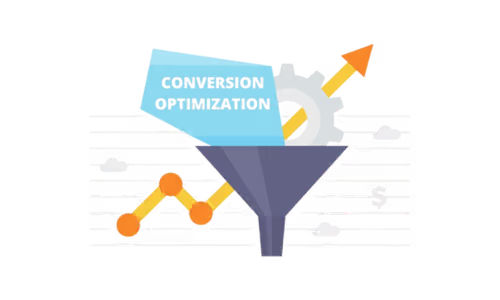
You are paying for traffic, but are you keeping it? If 98% of your visitors leave without buying, you have a Leaky Bucket. We identify the silent revenue killers, from friction-filled forms to mobile layout breaks, that cause users to bounce, ensuring you get the maximum ROI from every ad dollar you spend.
Are visitors landing on your page and bouncing immediately? Your value proposition might be unclear. We fix this by rewriting your headlines and restructuring your Above the Fold content to ensure visitors understand exactly what you do within 3 seconds.
Asking for too much information too soon kills conversion. If your contact form has 10 fields, nobody will fill it out. We optimize your User Input Fields, reducing friction and increasing form completion rates by up to 50%.
Is your “Buy” button hard to find? Is it the wrong color? We analyze user eye-tracking patterns. We place strategic CTAs (Call to Actions) exactly where users are looking, making the path to purchase obvious and irresistible.
Your site works on desktop, but is it impossible to use on a phone? With 70% of traffic being mobile, a bad mobile UX is a death sentence. We implement Mobile-First Optimization, ensuring buttons are thumb-friendly and checkouts are seamless on small screens.
Stop arguing over button colors. We replace opinions with hard data. Through rigorous A/B Split Testing, we scientifically prove which headlines, images, and layouts generate more money, ensuring every change we make is backed by statistical significance, not hunches.
We don’t guess. We install tracking tools to watch real users navigate your site. We see where they rage-click, where they scroll, and where they drop off.
We create two versions of a page (Version A vs. Version B). We test different headlines, images, and layouts to scientifically prove which one generates more money.
Running ads? We build dedicated, high-converting landing pages that match your ad copy perfectly, boosting your Quality Score and lowering your Cost Per Acquisition (CPA).
For E-commerce, the checkout is the critical moment. We remove distractions, add trust badges, and simplify the steps to reduce cart abandonment.
True optimization is a cycle, not a one-time fix. We follow a strict Optimization Loop: diagnosing the data with heatmaps, formulating a strategy, running the live experiment, and rolling out the winner. Once we win, we find the next problem and start again.
We install Heatmaps (Hotjar/Microsoft Clarity) and Analytics. We gather 30 days of data to find the “Red Flags.
We form a theory: If we move the testimonial section higher, trust will increase, and sales will go up.
We run the test live. 50% of visitors see the old site, 50% see the new change. We wait for statistical significance.
If the test wins, we make the change permanent. Then, we find the next problem and start again. It’s a continuous cycle of improvement.
CRO sounds technical, but the concept is simple: get more from what you have. We answer the most common questions about prerequisites, like how much traffic you actually need to run a valid test, and clarify how our changes impact your SEO and long-term sales.
It varies by industry, but typically 2-3% for E-commerce and 5-10% for Lead Gen is average. If you are below 1%, you have a serious problem that CRO needs to fix immediately.
Ideally, yes. To run statistically significant A/B tests, you need consistent traffic (at least 1,000+ visitors a month). If you have low traffic, we focus on “Heuristic Analysis” (Best Practices) instead of live testing.
No. In fact, CRO improves SEO. Google ranks sites higher that have good engagement metrics (low bounce rate, high time on page). Better UX leads to better rankings.
We use industry-standard tools like Google Optimize (or alternatives), Hotjar, Microsoft Clarity, and Google Analytics 4 to track user behavior.
A typical A/B test runs for 2 to 4 weeks to gather enough data to be accurate. We don’t stop tests early based on “gut feelings.”
We cannot guarantee a specific % increase because every market is different. However, our data-driven process rarely fails to find improvements. We usually aim for a 15-30% uplift in conversions.
Not usually. CRO is evolution, not revolution. We make iterative changes (tweaking a headline, moving a button) rather than rebuilding the whole site from scratch.
It can be, but it works best as an ongoing retainer. Consumer behavior changes, and there is always room to improve your conversion rate further.
Absolutely. For B2B, we optimize for Leads (Form fills, Phone calls) rather than direct sales. The psychology of persuasion is the same.